- Blackjack How To Count Cards
- True Count Blackjack
- Blackjack Strategy Count
- How To Count Cards Blackjack Rules
- Speed Count Blackjack
- True Count Blackjack Betting Strategy
- Blackjack Strategy Chart
- How To Count Cards In Blackjack Basic Strategy
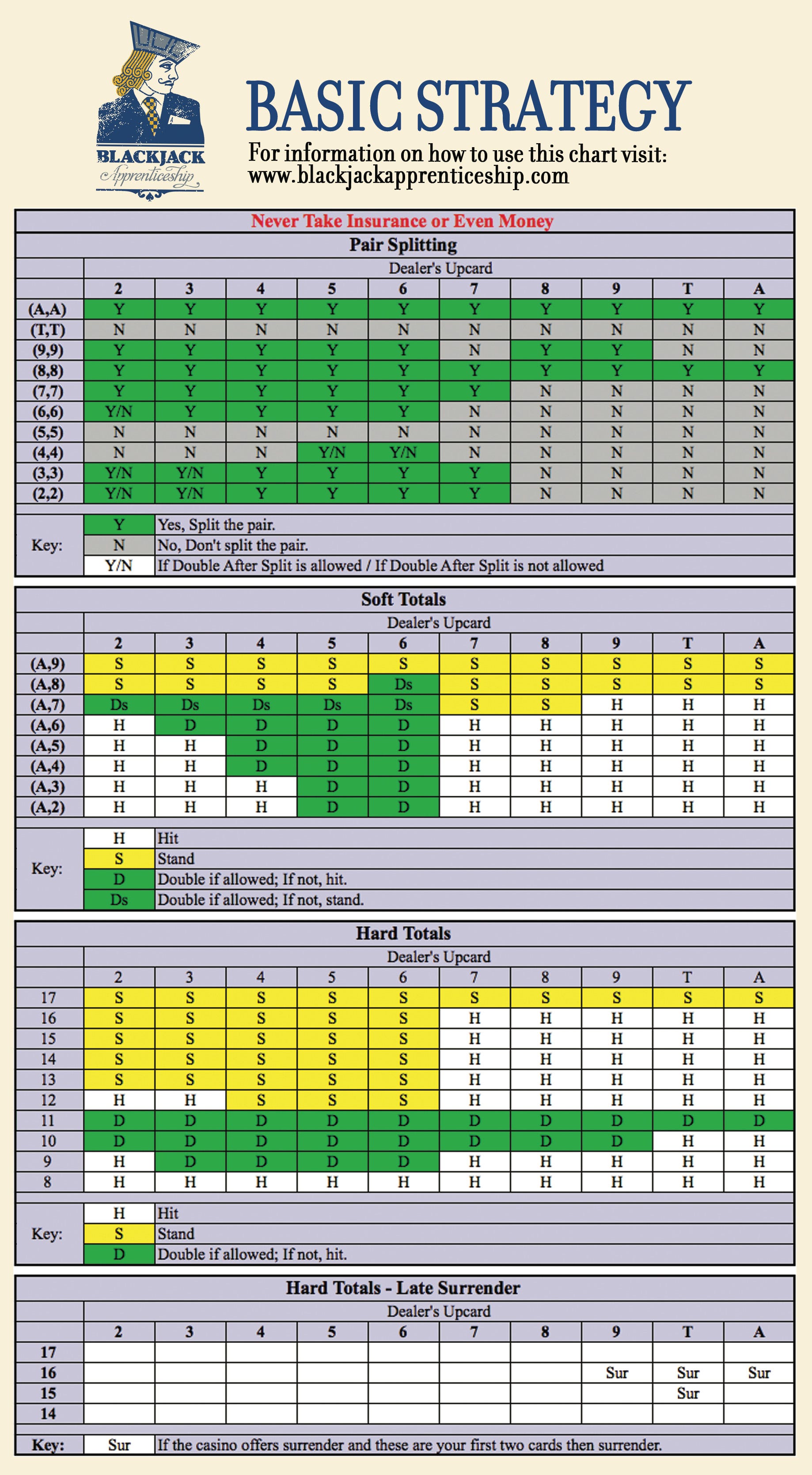
Card counters operate under the (correct) assumption that even perfect blackjack strategy is a losing proposition. That’s because basic strategy gives no indication of the likelihood of a dealer or player bust. Basic strategy requires you to hedge your bets in certain playing situations, meaning you are just as likely to win as to lose.
As more players learn to count cards, the edge on 3:2 blackjack grows thinner. Six to five blackjack more than makes up for the difference. Plus, casinos began using more decks per shoe, shuffling more often, and automatic shufflers because of card counters. When done well, card counting helps the average player make better choices.
- Dec 07, 2019 Basic blackjack strategy is the fundamental starting point for all beginner blackjack players and everyone interested in winning money playing 21. It’s fairly easy to learn basic blackjack strategy.You’ll find basic blackjack strategy cards making it even easy to learn are all the different basic strategy blackjack charts for various rules scenarios.
- Blackjack Card Counting Technique. Card counting strategy is primarily based on probabilities, and all the cards from the deck or decks are registered in the game table. Is this strategy, however, there is a small flaw: a few hands after the dealer discards the unplayed cards, the next hand can be organized from the re-mixed deck.
Keeping a running count improves on basic blackjack strategy by indicating when you can deviate from that strategy and still have a decent chance of winning. If you know there are more small cards than large ones, you can safely take hits on those pesky 15 and 16 point hands and improve your chances of beating the dealer. You can use a running count to know when to increase your bet size to maximize your profits, and when to decrease your bets to protect yourself from potential losses.
These changes in the bet size are known as a “betting spread,” a tool used by counters to increase profits and decrease losses without drawing the attention of the casino. Ideally, you can make small changes to your bets without the casino figuring out that you’re a card counter and (politely) asking you to leave.
Betting Spreads and Positive Expectation
The name of the game in card counting is turning blackjack into a positive expectation game. Peter Griffin’s book “The Theory of Blackjack” worked out some numbers pertinent to card counters. Using standard Las Vegas rules and a basic High-Low card counting system, a player’s advantage with perfect strategy when the count is zero is -0.56%. According to Griffin, each increase by 1 of the running count improves the player’s advantage by +0.5%. Naturally, every decrease by 1 of the count reduces the player’s advantage by 0.5%.
Blackjack How To Count Cards
Editor’s Picks for Best Online Blackjack in 2019
- Multiple blackjack games
- Publicly traded company
- Multi award winner
- Highly rated blackjack casino
- Vegas style blackjack
- Welcomes American players
$11,000
- Classic & progressive blackjack
- Weekly blackjack tournaments
- Great for U.S. based players
$4,000
- Vegas Style blackjack games
- Caters for American players
- Live 24/7 customer support
True Count Blackjack
$11,000
Positive Count and Percentages
We know that, statistically, a standard Vegas game of blackjack will only offer certain counts some of the time. Positive expectation only happens with a +2 count, which will only happen about 8% of the time. Truth be told, a positive count can only be expected about 18% of the time you’re playing–that’s why it is important to spread your bets, even if you’re keeping a running count and playing according to basic strategy.
What’s the Best Bet Spread?
People much smarter than you and me have determined that a bet spread between 1 and 5 units is the best way to avoid undue attention from the casino. By this reckoning, you should bet 1 unit for a +1 count, all neutral counts, and all negative counts. A +2 count means 2 units, a +3 count means 3 units, a +4 count means 4 units, and anything over +4 means you bet 5 units. Going over 5 units is likely to attract unwanted casino heat.
Using this system and perfect blackjack strategy, you can expect a positive return of about 0.14%. You’re not going to get rich with small wins under this system, but it will turn a negative expectation game into a positive one.
Larger Bet Spreads
The only way to increase your expectation is to use a 1-10 unit bet spread, which is sure to get you kicked out of any casino eventually. Still, as long as you can get away with a 1-10 unit spread, you can play with an edge of about 0.57%, or about three and a half times greater than with a 1-5 unit spread.
Since casinos have implemented rules and strategies to counteract card counting, the easy to beat blackjack tables have disappeared. Casinos are now instituting a 6:5 blackjack payout rule, for instance, that automatically makes the game not worth the time it takes to count cards and develop a bet spread. Perfect blackjack strategy is often as good as you can get at today’s blackjack tables, since even the most aggressive counting and bet spreading gives you only about a .5% edge.
Related News
Wizard Recommends
- €1500 Welcome Bonus
- €100 + 300 Free Spins
- 100% Welcome Bonus
On This Page
Introduction
The Hi-Lo Count is the most widely written about, and in my judgment, the most commonly used card counting strategy. The High-Low was first introduced in 1963 by Harvey Dubner1. It has since been discussed by just about all the major blackjack writers. In my opinion, the best introductory treatment is in Professional Blackjack by Stanford Wong, and the most detailed coverage is in Blackjack Attack by Don Schlesinger.
How it Works
Following is a brief explanation of how to use the Hi-Lo.
Step 1: Assign a point value to each rank, as follows.
High-Low Point Values
Step 2: Start with a 'Running Count' of zero at the start of the deck/shoe. As cards are revealed, keep adding or subtracting from the Running Count, according to the point system in step 1. For example, if the first ten cards to come out of the shoe were 3, 5, K, 7, Q, A, 8, 5, 4, 2, then the running count would be 1 +1 -1 +0 -1 -1 +0 +1 +1 +1 = +2.
Step 3: Divide the running count by the number of decks remaining, to get what is known as the 'True Count.' This is the part that beginning counters hate. You don?t need to be exact. A rough estimate will do, in my opinion. Let's look at example. The running count is +7 and there are about 4 decks left. The true count would be 7/4 = 1.75. Round that up to 2, to keep it simple. The more you play the more you will be comfortable eyeballing this adjustment, without doing any real division in your head. Usually the right play is obvious. In borderline cases only will you need to do this True Count conversion.
Step 4: The greater the true count, the more you should bet. This is where card counting becomes more art than science. Some blackjack books give rigid rules on how this should be done. However, the casino managers have read these books too, and the patterns recommended in earlier books now set off red flags. How you do this should depend on your own style, and how much heat you are getting. It helps avoid heat to keep the ratio of maximum bet to minimum bet to a limit, known as the ?Bet Spread.? Only increasing bets after a win, only decreasing after a loss, and staying the same after a push, makes play look more natural, but at a cost to profitability.
Step 5: For some hands, you will play according to the True Count and a table of 'Index Numbers,' rather than basic strategy. The greater the count, the more inclined you will be to stand, double, split, take insurance, and surrender. For example, the Index Number for a player 15 against a dealer 10 is +4. This means the player should stand if the True Count is +4 or higher, otherwise hit.
The following tables are known as the 'Illustrious 18' and 'Fab 4' respectively.2 They appear in Blackjack Attack by Don Schlesinger, and are republished here with permission. These are the most important index numbers to remember. Knowing only these will give the counter 80% to 85% of the value of knowing every index number, based on a six-deck game. The difference is more in single and double-deck games. The lists are given in order of value. If you can?t memorize all of them, start at the top, and work your way down.
Illustrious 18
| Order | Play | Index |
|---|---|---|
| 1 | Insurance | +3 |
| 2 | 16 Vs. 10 | +0 |
| 3 | 15 Vs. 10 | +4 |
| 4 | 10,10 Vs. 5 | +5 |
| 5 | 10,10 Vs. 6 | +4 |
| 6 | 10 Vs. 10 | +4 |
| 7 | 12 Vs. 3 | +2 |
| 8 | 12 Vs. 2 | +3 |
| 9 | 11 Vs. A | +1 |
| 10 | 9 Vs. 2 | +1 |
| 11 | 10 Vs. A | +4 |
| 12 | 9 Vs. 7 | +3 |
| 13 | 16 Vs. 9 | +5 |
| 14 | 13 Vs. 2 | -1 |
| 15 | 12 Vs. 4 | 0 |
| 16 | 12 Vs. 5 | -2 |
| 17 | 12 Vs. 6 | -1 |
| 18 | 13 Vs. 3 | -2 |
The player should stand/double/split if the True Count equals or exceeds the Index Number, otherwise hit. The player should take insurance if the True Count is +3 or greater.
Fab 4 Surrenders
| Order | Play | Index |
|---|---|---|
| 1 | 14 Vs. 10 | +3 |
| 2 | 15 Vs. 10 | +0 |
| 3 | 15 Vs. 9 | +2 |
| 4 | 15 Vs. A | +1 |
The player should surrender if the True Count equals or exceeds the Index Number.
A full table of all index numbers can be found in Chapter 3, and Appendix A, of Professional Blackjack by Stanford Wong.
The next table shows some statistics using the High-Low. The blackjack rules this table is based are liberal Vegas shoe, as follows:
Six decks
Dealer stands on soft 17
Surrender allowed
Double after split allowed
Player may resplit to four hands, including aces
To avoid setting off red flags, the simulation increased the bet after a win only, decreased after a loss only, and always stayed the same after a push, except resetting to a minimum bet after a shuffle. The simulation rounded the remaining decks to the nearest half deck, otherwise playing perfectly.
High-Low Statistics
| Spread | Penetration | Index Numbers | Player Adv. | Std. Dev. | Avg.Bet |
|---|---|---|---|---|---|
| 1 to 5 | 4 | I18+F4 | 0.157% | 1.50 | 1.35 |
| 1 to 10 | 4 | I18+F4 | 0.368% | 2.04 | 1.57 |
| 1 to 15 | 4 | I18+F4 | 0.578% | 2.67 | 1.73 |
| 1 to 5 | 4.5 | I18+F4 | 0.300% | 1.60 | 1.41 |
| 1 to 10 | 4.5 | I18+F4 | 0.587% | 2.27 | 1.68 |
| 1 to 15 | 4.5 | I18+F4 | 0.834% | 3.06 | 1.90 |
| 1 to 5 | 5 | I18+F4 | 0.469% | 1.70 | 1.47 |
| 1 to 10 | 5 | I18+F4 | 0.837% | 2.52 | 1.80 |
| 1 to 15 | 5 | I18+F4 | 1.147% | 3.49 | 2.10 |
| 1 to 5 | 4.5 | All | 0.313% | 1.61 | 1.41 |
| 1 to 10 | 4.5 | All | 0.608% | 2.29 | 1.68 |
| 1 to 15 | 4.5 | All | 0.862% | 3.10 | 1.91 |
| 1 to 5 | 5 | All | 0.494% | 1.71 | 1.47 |
| 1 to 10 | 5 | All | 0.857% | 2.55 | 1.81 |
| 1 to 15 | 5 | All | 1.182% | 3.54 | 2.11 |
Explantion of columns
Spread: This is the ratio of the player?s minimum bet to maximum bet. The bigger the range, the greater the player?s advantage, and bankroll volatility. A wide bet spread also sets off a red flag. In a six-deck game, I think a 1 to 15 spread is about the most aggressive the player should get. The simulation played one betting spot only.
Penetration: How many decks played before reaching the cut card. In a six-deck shoe, 4.5 is the norm.

Blackjack Strategy Count
Index Numbers: I already explained index numbers above. Simulations were run using both the Illustrious 18 and Fab 4 (I18+F4) above, and with the full table. The difference is not much, which shows that knowing the top 22 gets you most of the benefit of knowing all of them.
How To Count Cards Blackjack Rules
Player Advantage: This is the ratio of net player win to total initial bets. For example, in the last row, the player could expect to win 1.182% of his total initial bets.
Standard Deviation: This is a term for the volatility per initial bet.
Average Bet: The average final bet per hand, compared to the lowest bet For example, in the last row, if the player?s minimum bet were $100, his average bet would be $211. This includes additional money bet due to doubles and splits.
This table was created using CVCX Blackjack Analyzer by Casino Vérité. This software produces hundreds of different statistics for just about any set of rules, betting strategies, and playing strategies. For the player who wants to run these tests, this software is the best there is, in my opinion.
Footnotes
Speed Count Blackjack

- Professional Blackjack by Stanford Wong, page 31, 1994 ed.
- Blackjack Attack by Don Schlesinger, page 62, 2004 ed.
Acknowledgments
Don Schlesinger: For his permission to reprint the Illustrious 18 and Fab 4 tables from his book, Blackjack Attack.
Norman Wattenberger: For his complimentary use of CVCX Blackjack Analyzer by Casino Vérité.
True Count Blackjack Betting Strategy
Practice
Practice your card counting skills with our trainer.
Blackjack Strategy Chart
Further Reading
How To Count Cards In Blackjack Basic Strategy
- Card Counting Introduction.
- Wizard Ace-Five Count: Very easy and simple card counting strategy.
- '21' Movie Review: Truth and fiction about the movie about the MIT card counting team.
- Blackjack book reviews.
- Main blackjack page.