Blackjack strategy charts are the key to memorizing basic strategy. You probably already know that blackjack offers some of the best odds in the casino, but the catch is that you have to make the correct decisions in order to enjoy those odds. This suits players with the right temperament. Players who have no interest in learning basic strategy should stick with games like slot machines.
To basic strategy blackjack players aces and eights have entirely different meanings. The common wisdom spouted by experienced players, dealers and pit bosses, is: 'Always split aces and eights.' Virtually all players would agree that splitting aces makes sense as blackjack basic strategy. Who wouldn't trade one hand starting with a total of 12.
How Basic Strategy Works
Blackjack Split Aces

There is a single mathematically correct decision for every situation you’ll encounter in a casino blackjack game. A blackjack strategy chart puts every decision into a color-coded chart to help people with a visual learning style memorize that information. The chart explains when to hit, when to stand, when to double down, and when to split.
Most casinos have no problem with players using a basic strategy card at the table. Even when you play perfectly, the casino retains a mathematical advantage, so they know they’ll be winners in the long run. Of course, if you combine card counting or shuffle tracking with your use of basic strategy, you can gain an edge over the casino, but it takes more than a color coded chart to do that.
How Basic Strategy Charts Are Organized
A basic strategy chart for blackjack is organized along two axes. The horizontal axis is labeled across the top, and it represents the dealer’s upcard, which is always going to be one of 10 cards: 2 through A. The vertical axis is labeled across the left side, and it consists of the various player totals that are possible.
These player totals are organized by type. A blackjack hand can consist of 3 different kinds of hands:
A hard hand is a hand without an ace, although it’s also a hand where an ace has to be counted as “1” in order to avoid busting. Your strategy chart is going to cross-reference all hard totals of between 8 and 17 along the side with the dealer cards of 2 through A across the top. You’ll always hit a hard 8 or less, and you’ll always stand on a hard 17 or higher. The other totals require decisions based on the dealer’s upcard.
A soft hand is a hand with an ace, in which the ace can count as a “1” or as an “11”. The soft totals are 13 through 20. You’ll always stand on a soft 19 or a soft 20, but the other totals require decisions.
Pairs are hands that consist of 2 cards of the same rank. For example, 22 and 33 are both pairs, and these hands require different decisions because you have the option of splitting pairs. When you split a pair, you place an additional bet, and the two cards in your original hand become the first cards of two new hands. You’ve probably heard that you should always split aces and eights, and you might have heard that you never split 4s, 5s, or 10s, but the basic strategy chart will provide you with specific instructions for every possible pair.
Blackjack strategy charts are a grid with 28 horizontal rows and 10 vertical columns. That means that there are a total of 280 different decisions to learn, but since many of them are the same, it’s not hard to learn them reasonably quickly.
For example, once you realize that you always hit a hard 8 or less, and that you always stand on a hard 17 or higher, you’ve memorized 20 of the 280 decisions. When you realize that you always split aces and eights, and you never split 4s, 5s, and 10s, then you’ve memorized a total of 50 out of 280 decisions, which is almost 20% of the basic strategy chart right there.
What Basic Strategy Will Do for You
Basic strategy will make sure that you’re playing against the house with the lowest possible house edge. That means that you’ll lose (on average) less money than would if you weren’t using basic strategy. What does that mean over the long run?
If you’re not using basic strategy, the house has an edge of between 2% and 5%. Taking the median, that means over time you’ll lose $3.50 for every $100 you wager on the game—assuming you play long enough to reach the expectation.
Assuming that you play an average of 60 hands per hour at $100 per hand, you’re looking at losing an average of $210 per hour over time at that rate.
On the other hand, if you’re using basic strategy, you can reasonably expect to reduce the house edge to 1%. That means you’ll lose $60 per hour on average over time. That’s a big difference in the cost of your entertainment.
What Basic Strategy Won’t Do for You
Basic strategy won’t give you an advantage over the casino. Advantage play methods that give you an edge over the casino exist, but they require more work than just using perfect strategy. In fact, before you can get an edge over the casino by using card counting or shuffle tracking, you have to master basic strategy first.
Once you’ve mastered basic strategy, you can learn how to count cards, and you can get an advantage of between 0.5% and 1% over the casino. If you’re playing $100 per hand on average, at 60 hands per hour, then you could theoretically earn between $30 and $60 per hour counting cards.
But keep in mind that this is a combination of basic strategy and another technique. Basic strategy is just the beginning of blackjack wisdom. Entire vistas of knowledge become available eventually, but they all start with the memorization of a basic strategy chart.
If you’ve been playing blackjack for a while, you know when to hit and when to stand. But do you know when to split? Anytime you get dealt a pair, you have the option of splitting that pair into two separate hands. Many casinos also allow you to split mixed pairs, meaning any two cards with a value of 10. You’ll find many veteran blackjack players who won’t hesitate to split all these pairs, and they’ll tell you to do the same.
Don’t do it. There is a time to split your pair, and a time to keep your cards together. In addition to the dealer’s upcard, your decision to split or not depends on five factors:
1. How many decks of cards are in the shoe?
2. Does the dealer hit or stand on soft 17?
3. Are surrenders allowed?
4. Can you double down after splitting?
5. Does the dealer “peek” to see if he has blackjack?
Each variable requires you to tweak your splitting strategy if you want to play optimally. But if you already take blackjack seriously, you won’t find it too difficult to figure out. Start with these general rules that apply to every situation:
Always Split Aces and Eights
If you get dealt two shiny Aces, you simply have to split those and go for two blackjacks. Then you should double down if your casino allows it. Many locations (including Ignition Casino) allow you to receive only one more card after you split your Aces; in this case, doubling the bet makes even more sense, and there are a lot of Tens through Kings to help you get there. Eights should be split so you don’t have 16 in your hand – you’ve got a good shot at getting at least one 18 out of the bargain instead.
Never Split Fives and Tens
Pairs of Tens and mixed pairs should never be split, because you’ve already got 20. And if you’ve got a pair of Fives, you’re holding 10, which is a solid starting point; again, you should double down with this hand, provided the dealer’s upcard isn’t also worth 10 or more. Just don’t split them first.
Blackjack Splitting Aces
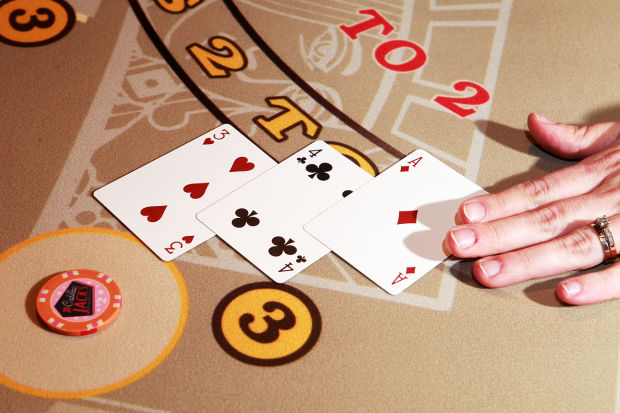
Always Split Aces And Eights Blackjack
There’s one more hand that you can treat the same in virtually all forms of blackjack: a pair of Fours. Even some of the top players will recommend you never split Fours; if the dealer’s upcard is a Five or a Six, they’ll tell you to double down instead. But there are a few rare occasions where it makes sense to split those Fours. The game has to allow for doubling after splitting, and again, the dealer’s upcard has to be a Five or Six – or even another Four, if it’s Single Deck Blackjack. The more of these subtleties you can pick up, the more money you’ll make, so take the time to learn if you want to make the move from blackjack enthusiast to blackjack expert.